
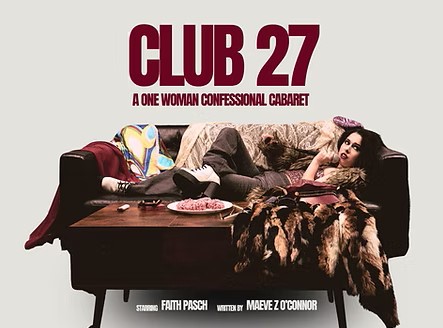
CLUB 27, a one-woman cabaret confessional, is lying to you. Written by Maeve O’Connor, directed by Kara Alexandra, and performed by Faith Pasch, CLUB 27 is a hybrid Cabaret, Lecture, and performance piece that stabs at the deep, nightmare-inducing anxiety that lies at the heart of every performer on the cusp of ‘making it’: Is it too late for me? For many of us, theater feels like a young person’s game, and as Pasch repeats to us, ad nauseam, by 27 you should either be “Famous or Dead”. Pasch, as The Host, draws inspiration from her time as a lounge singer to draw a portrait of the infamous 27 Club, the Olympus of great artists and singers who managed to pull off both by age 27 (Diagram attached). Amy Winehouse, Janis Joplin, Kurt Cobain, and Jimi Hendrix are all ghosts that swirl around the room, brought out by Pasch’s star power singing, taunting The Host from beyond the grave. She parties like a rock star, drinks like one, sure as shit sings like one, so why hasn’t The Host (and truthfully Pasch) become famous
like one?
Here’s where the lie comes in. CLUB 27 is not a one-woman show. Alex Parrish here is providing musical accompaniment in the role of ‘The Pianist’, but in reality is probably just the
Devil. Capital D, Devil, who met Robert Johnson at the crossroads and kicked off the whole 27 Club in the first place, according to some popular folklore. Parrish is a goading, gloating figure here, drawing Pasch further and further into a very dark place. One part task master, one part very bad influence, Old Scratch here seems to embody the kind of temptation that pushes artists into the kind of life that ends with a 27 Club membership.
As said before, Pasch as a singer in her own right doesn’t pull any punches, and delivers show-stoppers with rapid, effortless succession. As the hits keep coming, Pasch’s lecture/confessional hits just as hard, as the stories of tortured artists are recanted with a depth of emotional resonance that makes you believe they’re right there in the room with us. Pasch’s energy is loud, bold, and infectious. The audience is clapping along one moment and tearing up the next, as The Host stumbles across the room in the kind of Dionysian divine madness.
Unfortunately, the more supernatural elements of the performance land with a thud, with the Pianists’ clunky lines distracting us from a lot of the emotional core of Pasch’s performance. It feels unnecessary at the best of times, and it results in dialogue that starts to edge into ‘Morality
play’ territory.
The resolution of The Host’s journey is for her to choose door number three. If the choices are between being dead or famous, then she would rather be happy. Pasch resoundingly rejects the
push-push-push that forces great artists to burn out (or worse) and takes a stance against the toxic celebrity culture that lionizes youth. It’s very clear that Pasch deserves to be remembered alongside the greats, 27 Club or no.

