
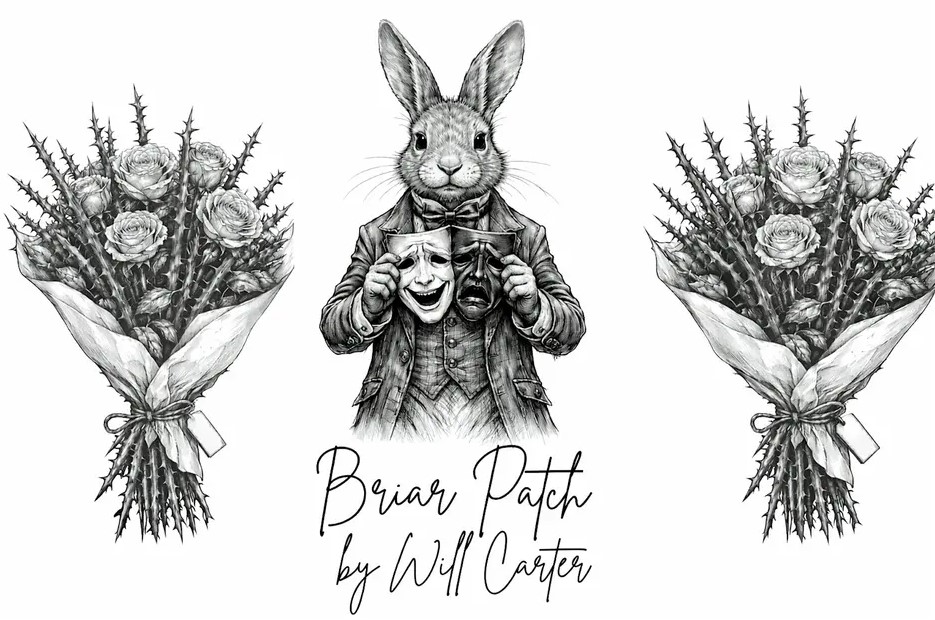
The stage reading of BRIAR PATCH managed the impossible by being both deeply anxiety-inducing and incredibly boring. An original script by Will Carter, BRIAR PATCH looks to dissect the life and work of William Chandler Harris by way of a modern reimagining of his most famous work, The Uncle Remus Stories. This is, pardon a pun, a deeply thorny subject
matter to interrogate, and it’s impossible to discuss Harris without giving away something about your own biases. Carter is largely positive on Harris, opting to take a wide view of Harris’s body of work, and his anti-lynching, pro-education writings in the post-Reconstruction South.
Unfortunately, this doesn’t stop the little voice in the back of my mind wondering if Carter is really the person who should be the one spearheading Harris’ public rehabilitation.
The real meat and potatoes of BRIAR PATCH focus on the town of Eatonton, Georgia (Harris’ birthplace), and the very real racial tensions that arise when a young black man is exposed to the racial inequities of the southern judicial system. For an adaptation of stories that are all rather straightforward, BRIAR PATCH turns into a Rube Goldberg machine of plot contrivances designed to put the ensemble into a place where Carter can have his cake and eat it too. The core of the narrative revolves around having the accused Malcolm (Justin Diaz) and his grandfather Sherman (Rodrikus Springfield) Singleton put on a stage adaptation of a Br’er Rabbit tale as a form of community service to appease the judge that’s about to throw the book at him. It’s multiple layers of complexity all stacked on top of each other in such a dull balancing act that the
audience struggles to find their footing within the scheme, if they’re even trying.
For a play that is ostensibly about Harris’s legacy, very little of him is actually present within BRIAR PATCH. The cast plays a drawn-out will they/won’t they game with how exactly they
plan on adapting Br’er Rabbit, and there’s a real ‘the play’s the thing’ logic going on under the hood. Much of it serves the dual purpose of giving an outlet to present the Uncle Remus Stories,
but also to present a thorny (there’s that pun again) discussion of the appropriation of the enslaved and indigenous folk traditions that made Harris a household name. Unfortunately, so much time is spent neatly arranging all the moving parts into place that the final verdict on Harris needs to be delivered via a literal English history lecture at the script’s 11th hour.
The grand final is, of course, a show-within-a-show adaptation of the one Br’er Rabbit story, verbatim, whose title has now become a racial slur. All done dispassionately within the final
moments, complete with an unnervingly faithful portrayal of Uncle Rameus on stage. It’s a bizarre and thudding moment, and the play ends very abruptly soon after, never giving the
characters or audience a moment to truly digest what they just saw. For all the care that went into BRIAR PATCH, it ultimately collapses under the weight of how taboo its subject matter is,
never presenting a novel apologia for Harris’ legacy. It’s very clear Carter is passionate about
Harris, and there clearly is work that needs to be done reevaluating his writings, but we’re not
exactly making a dollar a minute in BRIAR PATCH.
 The Independent Artists movement