
Tucked away in the enclaves of Arizona exurbs, the sun will melt your brain if the algorithm doesn’t do it first. Writer Scott Brooks and director Ashley Olive Teague introduce us to a tableau that has become a staple of ensemble drama. A dusty and remote neighborhood where the only pastimes are ogling your neighbor’s wife, stewing in past regrets, and getting a bit too drunk at social functions. Stop me if you’ve heard this one before. But in the conjoined backyard of WHATEVER, Brooks introduces two intriguing twists.
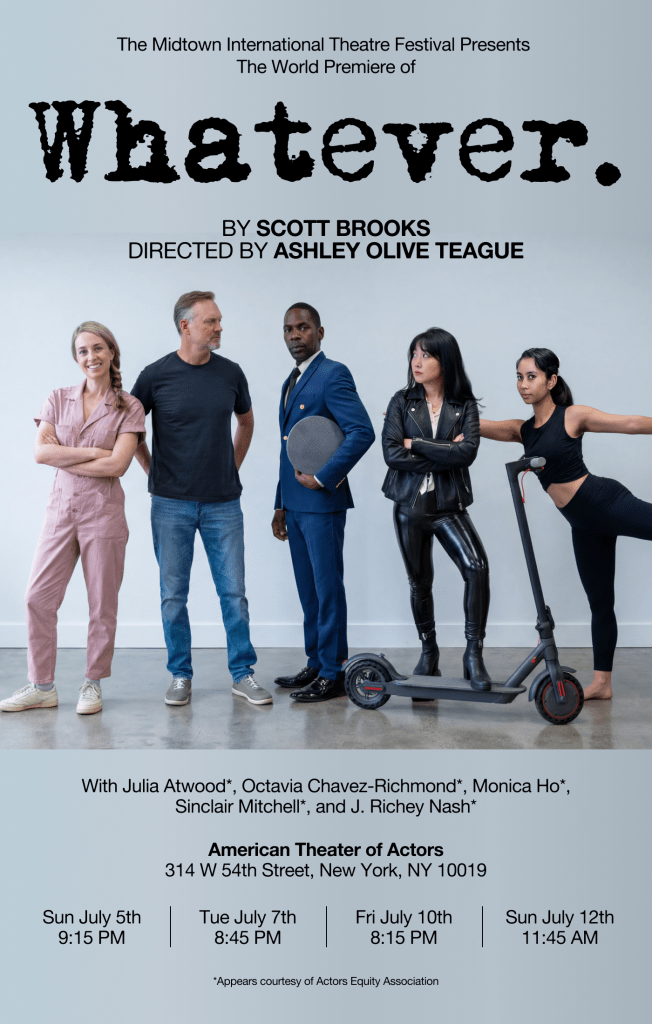
Firstly, a tantalizing mystery at the heart of the drama: Former Navy pilot David, played here by the incredible Sinclair Mitchell, is being paid lavishly to remain in perpetual standby, at the beck and call of a hidden benefactor whom he is NDA bound from even naming. Neither his fitness-guru spouse, Luna (Olivia Miller), nor his washed-up major-league baseball neighbor, ‘cooch’ (J. Richey Nash), knows any details. And the few tantalizing clues he’s revealed to his neighbor’s Ms. Rachel knockoff influencer wife, Chrissy (Julia Atwood), by way of their affair, only allows her to glimpse the blurry edges of the
grand conspiracy. More on that later.
The second key theme that Brooks plays heavily into is the proliferation of social media and algorithms into both our real and digital realities. Both Luna and Chrissy make their living at the behest of The Algorithm, and both find themselves sucked into the doom scroll as the only true means of connection
with a world outside their backyard. It’s a theme that starts lighthearted, jokes about the power of coffee enemas and the ephemeral nature of internet celebrity, but quickly turns grim as the outside world is hit by a novel virus and assorted demi-apolocplyptic events. Complete with all the misinformation that spreads further than any pathogen ever could.
Or, what seems like a virus?
This is where the script begins to fall apart, as the mystery, paranoia, and delusions of the setting begin to get explained, and then over-explained, and then explained again to the point of meaninglessness. By the second half of the play, we’re introduced to the character of Ruby (Monica Ho), who exists entirely to catch the audience up to speed with increasingly convoluted and dull exposition. Telling, instead of showing, answers to all of the mysteries. It’s frustrating; it made me want to jump out of my seat and exclaim, “Stop! Stop! It doesn’t matter if the virus is fake. It doesn’t matter that David’s boss built a rogue AI that’s Slop-posting everyone’s brains into Jell-O. It doesn’t matter if David’s boss has put him on standby to flee to a doomsday bunker. None of that matters! It all works when the audience isn’t given perfect information. It’s about the uncertainty! IT’S ABOUT THE RELATIONSHIPS!” But I
suspect if I did that I would have gotten kicked out of the theater.
There’s a part at the end that I think is very emblematic of how it all goes wrong, as the final moments of the play have Chrissy interrupting a slow dance with her husband to begin baking the lyrics of Goodbye Yellow Brick Road. Baking, for those of you who are blissfully unaware, is a form of conspiratorial
thinking wherein supposed clues or unrelated symbols are mashed together into larger grand theories.
This moment is tragic. David has just been activated and jetted off to who knows where, imparting a final goodbye to Chrissy in the form of a song they shared together. Chrissy, in a state of delusion, hears the line about “Shooting down a plane” and begins spinning her wheels about hidden messages and secret codes. In this moment she has succumbed to the paranoia and fear that Ruby claims is gripping the world, literally pulling away from reality to wallow in fantasy.
I mean, it would be tragic, if it weren’t for the scene prior where Ruby glibly remarks to Luna that her ex-boyfriend is some kind of Kaczynskian eco terrorist who plans to shoot down the jet David will be boarding. And if it wasn’t immediately followed by Cooch whipping out his iPad to find a breaking news
alert that her suspicions are correct.
This is ultimately what I mean when I say the show overexplains itself to the point of meaninglessness. For a show about the slow creep of paranoia, dread, and mistrust that accompanies the total AI takeover of our lives, the script constantly bends over backwards to make sure that nothing is left up to the imagination. What could have been a tight, modern Twilight Zone instead balloons out into a whole that
feels less than the sum of its parts, and in the end I walked out of the theater feeling very whatever.

